Smart Bulbs vs Smart Switches: Which Should You Choose?
It’s one of the first real decisions you’ll face when stepping into smart lighting, and it trips up almost everyone: should you buy smart bulbs, or smart switches? They sound like two ways of doing the same thing — making your lights controllable from your phone or your voice — but underneath, they work very differently, cost very differently, and suit very different homes.
Pick the wrong one and you’ll either overspend, end up with lights that confuse your houseguests, or hit a wall the moment you try to expand. Pick the right one and your setup is cheaper, more reliable, and genuinely pleasant to live with.
This guide breaks down the real differences — installation, cost, control, and reliability — and then gives you a clear, scenario-by-scenario answer. Because the honest truth is that “smart bulbs vs smart switches” usually isn’t a battle with one winner. It’s a question of matching the right tool to the right room.
What Is a Smart Bulb?
A smart bulb is exactly what it sounds like: a light bulb with the “smart” built directly into the bulb itself. It screws into your existing fixture or lamp like any ordinary bulb, then connects to your home — over Wi-Fi, Bluetooth, or a hub — so you can control it from an app or a voice assistant.
The appeal is obvious. Installation is as easy as changing a light bulb, because that’s literally what it is. No wiring, no tools, no electrician. You can dim it, schedule it, and — with colour bulbs — shift it through millions of shades and white temperatures. For renters and beginners, smart bulbs are the natural starting point: cheap to try, impossible to install wrong, and easy to take with you when you move.
The catch is that the intelligence lives in each individual bulb. That has consequences we’ll come back to.

What Is a Smart Switch?
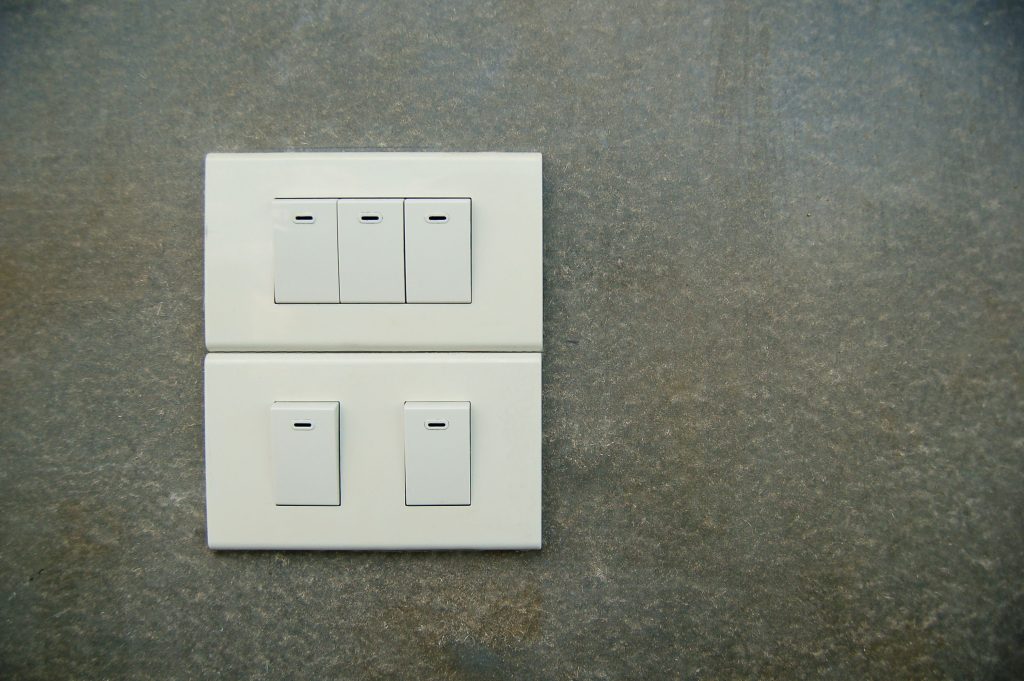
A smart switch puts the intelligence in the wall, not the bulb. It replaces your existing light switch, and from there it controls whatever ordinary (“dumb”) bulbs are wired to it — giving them smart features like remote control, scheduling, and voice commands, without those bulbs being smart at all.
This flips the whole model. Instead of making each bulb smart, you make the circuit smart at a single point. One switch can control a six-bulb chandelier, a row of downlights, or a whole room’s main lighting — all at once.
The trade-off is installation. A smart switch involves wiring: turning off the power at the breaker, removing the old switch, and connecting the new one. Many smart switches also need a neutral wire in the wall box, which older homes don’t always have. It’s manageable for a confident DIYer, but it’s a real install — and in many cases a job for an electrician.
The Key Differences at a Glance
Here’s how the two stack up on the things that actually matter:
| Smart Bulbs | Smart Switches | |
|---|---|---|
| Installation | Screw in — no tools | Wiring required; may need a neutral wire |
| Renter-friendly? | Yes — easy to remove and take | No — semi-permanent, modifies wiring |
| Cost for one light | Cheaper (one bulb) | Pricier (one switch) |
| Cost for many bulbs | Adds up fast (each bulb is smart) | Cheaper — one switch covers the whole fixture |
| Colour & scenes | Yes — full colour, dimming, scenes | No colour (uses normal bulbs); dimming varies |
| Wall switch problem | Switch must stay ON to work | Works exactly like a normal switch |
| Reliability | Depends on each bulb’s connection | Generally more reliable, hardwired |
Two rows in that table deserve a closer look, because they cause the most real-world frustration.
The Two Problems Nobody Warns Beginners About
The “wall switch” problem (smart bulbs)
This one catches almost everyone. A smart bulb only works if it has power — which means the wall switch has to stay in the ON position permanently. Flip the switch off out of habit, and the bulb loses power: no app control, no voice, no schedule. It’s just off, like any dead bulb.
In a household where other people (or guests) instinctively hit the wall switch, this is a constant low-level annoyance. You end up putting little reminders over switches, or swapping in switch guards. It’s livable, but it’s the single most common smart-bulb regret.
The cost-scaling problem
A single smart bulb looks cheap — often under $15. A single smart switch costs more. So bulbs win, right?
Only for one light. The maths flips the moment a fixture has multiple bulbs. If one switch controls six downlights, you’re choosing between one smart switch or six smart bulbs. Suddenly the switch is far cheaper, and you only had to set up one device instead of six. For main room lighting with lots of bulbs, switches win on cost decisively. For a single lamp, bulbs win.
When to Choose Smart Bulbs
Smart bulbs are the better choice when:
- You rent. No wiring changes, nothing to repair on move-out, and you take them with you. This alone makes bulbs the default for most renters.
- You want colour or scenes. Switches control ordinary bulbs, so they can’t do colour. If you want a warm amber movie scene or a cool white for reading, you need smart bulbs.
- It’s a lamp or a single-bulb fixture. One bulb, one cheap device, done.
- You want accent or mood lighting. Bedside lamps, shelves, corners — anywhere the quality and colour of light is the point.
- You’re nervous about wiring. Screwing in a bulb is foolproof. If electrical work makes you uneasy, bulbs remove that barrier entirely.
When to Choose Smart Switches
Smart switches are the better choice when:
- You own your home. You can modify the wiring once and enjoy it for years.
- A fixture has many bulbs. Chandeliers, downlight arrays, multi-bulb fixtures — one switch beats many bulbs on both cost and simplicity.
- It’s main room lighting. The lights you turn on and off as a group, every day, in kitchens, living rooms, and hallways.
- Other people use the switches. Because a smart switch is a switch, family and guests use it normally — no confusion, no “why won’t the light turn on?”
- You want to keep good bulbs you already have. If you’ve already got quality LEDs installed, a switch makes them smart without replacing them.
- The bulbs are hard to reach. High ceilings and awkward fixtures make swapping in smart bulbs a pain; a switch at standing height sidesteps that.
The Real Answer: Use Both
Here’s the part the “vs” framing hides. For most homes, the smartest setup isn’t bulbs or switches — it’s both, room by room.
The winning pattern looks like this:
- Smart switches for your main, everyday lighting — the multi-bulb fixtures and primary room lights you control as a group.
- Smart bulbs for lamps, accent lighting, and any spot where colour and mood matter.
This hybrid approach gives you the cost-efficiency and reliability of switches where you have lots of bulbs, and the colour and flexibility of bulbs where it actually counts — while sidestepping the worst of each one’s downsides. You stop fighting the wall-switch problem on your main lights, and you stop overpaying to make a six-bulb fixture colourful when you never needed colour there anyway.
The trick is to decide per room, not per home. Walk through your space and ask, fixture by fixture: is this about mood and colour (bulb territory) or everyday on-off control of a group (switch territory)? The answer is usually obvious once you ask the question that way.
Conclusion
Smart bulbs vs smart switches was never really a fight to the death. Bulbs are the renter-friendly, colour-rich, screw-in-and-go option — unbeatable for lamps, accents, and anyone who can’t or won’t touch wiring. Switches are the cost-effective, reliable, guest-proof option — the right call for main lighting, multi-bulb fixtures, and homes you own.
If you’re just starting out and want one rule of thumb: renters and colour-lovers start with bulbs; homeowners with multi-bulb fixtures start with switches — and almost everyone ends up with a mix. Buy for the room in front of you, not for some imagined whole-house system, and you’ll spend less and enjoy it more.
The wall switch problem is the most decisive argument in this whole debate — not because it’s technically serious, but because it reveals something deeper. A technology that requires changing the behavior of everyone who lives with you is always going to lose in the long run. Your family, your guests, your half-asleep self at 7am — someone is going to flip that switch off. Every time it happens, the tech will feel broken even when it’s working perfectly.
That, more than cost or installation, is what sold me on the hybrid approach. It’s not a reluctant compromise — it’s accepting that different spaces have different use patterns. The living room needs reliability and a light anyone can turn on without thinking; the bedside lamp needs mood, color, and control from under the covers. Trying to force one type of device to do both is the wrong question. The right question is the one you ask room by room: what problem am I actually solving here? That question alone will probably save you more money than any smart bulb sale ever will.